 中文
 英文
 俄文


Introduction: The "last centimeter" precision assembly in industry is being redefined by dexterous hands.
The Dilemma
A Single Cable Tie Holding Up the Entire Production Line
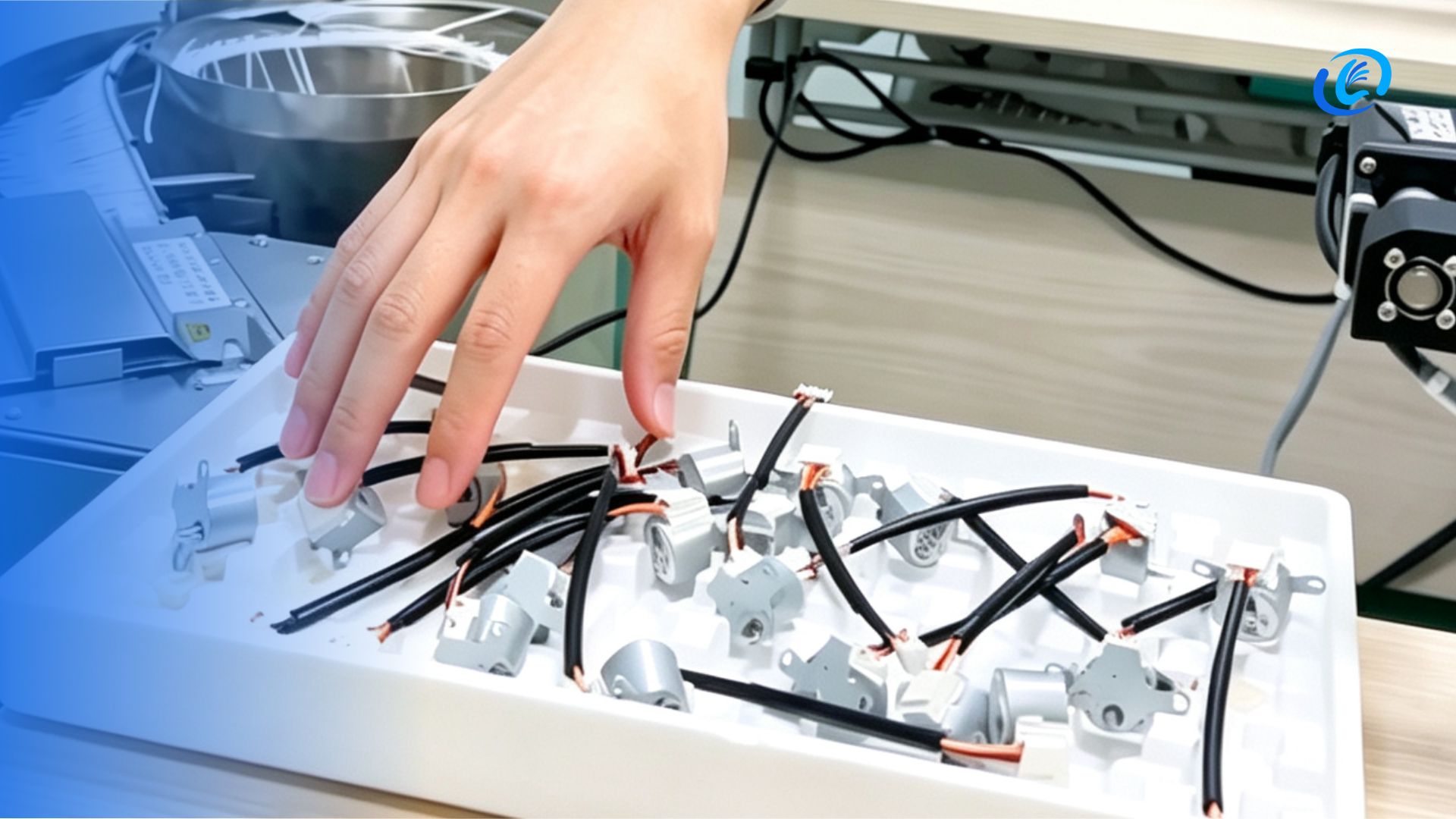
In motor assembly workshops, cable tie bundling is one of the most inconspicuous yet stubborn processes.
Grasping terminals, straightening wires, and fastening cable ties — these three seemingly simple steps have long relied on manual operation. Industry data shows that the production and assembly of wiring harnesses still largely depend on manual labor. In particular, post-processes of harnesses (routing, inserting connectors, installing waterproof plugs, taping, branch assembly, etc.) account for 40%–60% of the total harness production man-hours.
Why is automation struggling here?
The core challenge lies in flexibility. Wiring harnesses are flexible, deformable and prone to tangling. Traditional grippers only have two states: open and closed. Faced with disorganized wires, they either fail to grip or snag extra conductors.
More importantly, it is a multi-step task. Cable tie bundling is not a single action, but a continuous sequence of "grasping → wire straightening → bundling". Conventional automated equipment can complete one of these steps, yet cannot realize full multi-step coordinated operation.
The result: One workstation on one production line requires one operator repeating the same task hundreds of times a day. It suffers from low efficiency, poor consistency and recruitment difficulties. The overall automation rate of such lines remains below 10%.
Breakthrough
Others Build Hardware; We Deliver Closed-Loop Systems
Most dexterous hand manufacturers on the market focus solely on the hardware of the hand itself — selling the end effector while leaving customers to integrate vision systems, develop algorithms and conduct commissioning independently. What industrial sites actually need is not merely "a hand", but a ready-to-operate workstation.
The production line of Lu'an Leili Motor was once trapped in this common industry bottleneck until the dexterous hand solution from Zhongke Lingxi was deployed. It redefines assembly through a complete "hand-eye-arm-brain" closed-loop system.
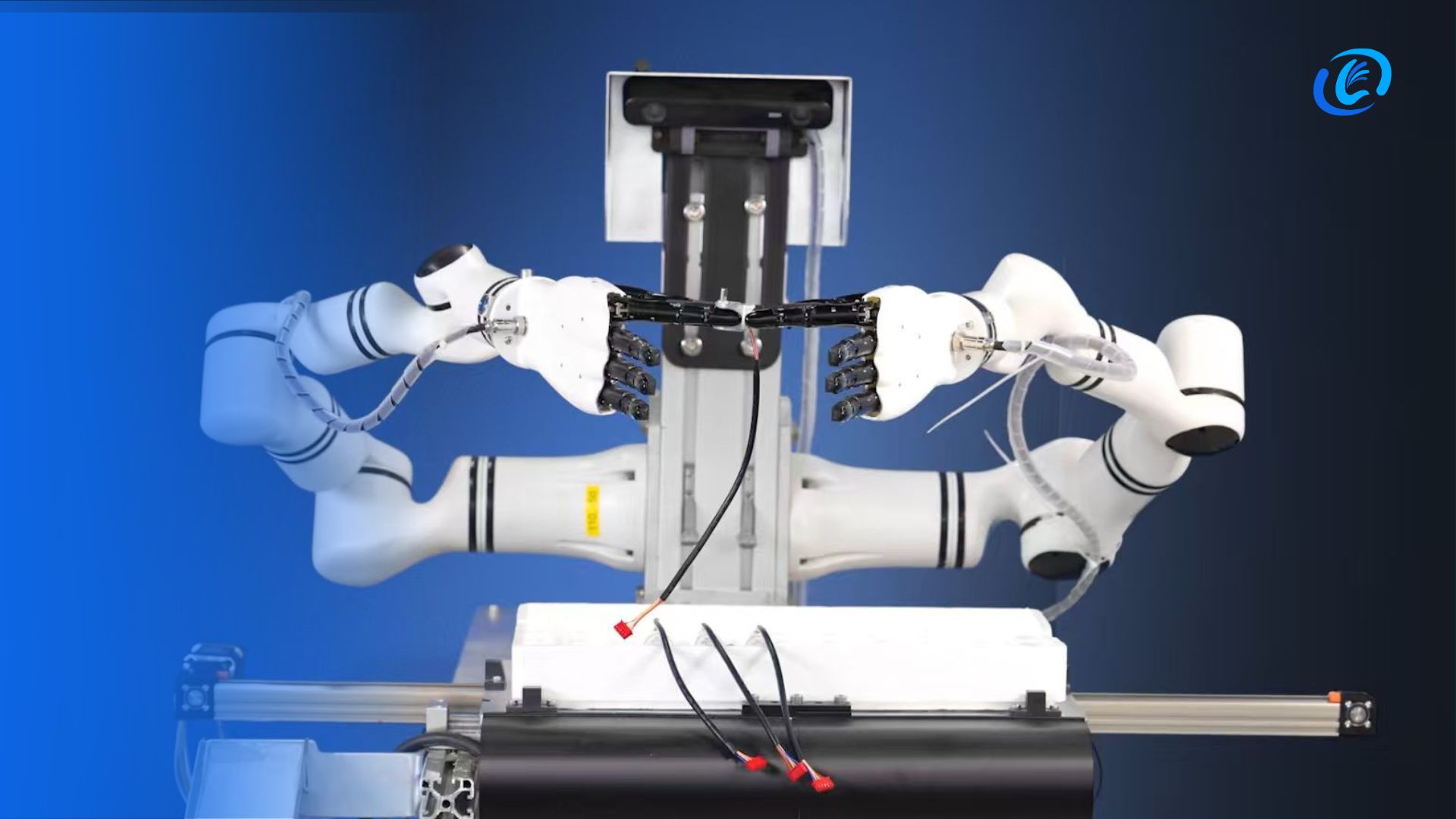
Centered on linkage-type dexterous hands as the end effector, Zhongke Lingxi integrates 3D vision and dual bionic arms to build an integrated intelligent assembly system of "hand-eye-arm-brain":
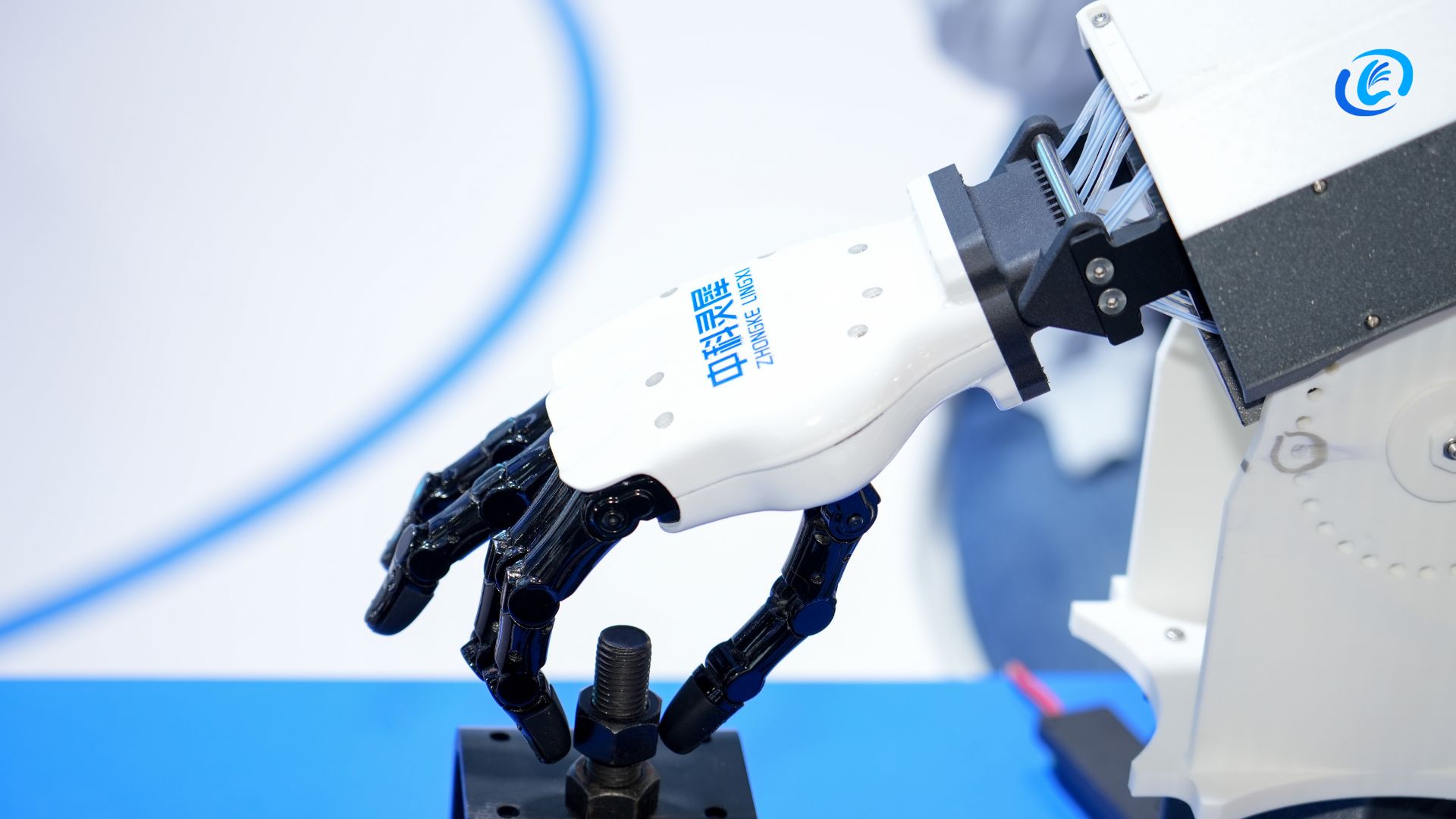
Hand — The linkage dexterous hand replicates fine manual manipulation. Equipped with force and tactile sensors, it delivers a fingertip force of 12N per finger, an overall gripping force of 80N, a static payload of 20kg, a fingertip rotation speed of 360°/s, and a response latency under 1ms. Faced with terminals of varying sizes and wires running in different directions, the dexterous hand automatically adjusts its gripping posture and force, instead of rigid clamping with fixtures. Notably, modular replacement can be finished within 3 minutes — a damaged finger can be replaced separately without sending the entire hand back to the factory.
Eye — The 3D vision system identifies terminal positions and wire routing in real time with submillimeter-level accuracy. Supported by three core capabilities: adaptive enveloping grasping with multi-fingers, precise positioning via multi-joint fine-tuning, and real-time force control with tactile feedback, the dexterous hand handles irregular components and dynamic disturbances.
Arm — Dual robotic arms work in coordination: one grasps terminals while the other straightens wires and applies cable ties. Parallel operation avoids mutual interference and greatly shortens the overall cycle time.
Brain — Coordinated planning algorithms for global path optimization and closed-loop control. The system can not only "see" but also "reason": it plans the optimal grasping path, action sequence and force distribution.
The four modules — hand, eye, arm and brain — perform their respective functions and interconnect closely: vision handles perception and positioning, algorithms make path decisions, dual arms execute coordinated delivery, and the dexterous hand carries out delicate operations. Seamless data communication and collaboration between them form a truly complete intelligent assembly system.
Most competitors can manufacture the "hand", yet cannot build the closed loop of "eye, arm and brain". The value of this system does not lie in superior performance of a single component, but in independent R&D and full interconnection of all four modules. Customers do not need to source vision hardware, program algorithms or tune the system by themselves. What they receive is a complete, out-of-the-box workstation.
The Solution
Full Process in 9 Seconds, Two Units Replace One Operator
This system has undergone nearly one year of verification under real working conditions on the production line of Lu'an Leili Motor.
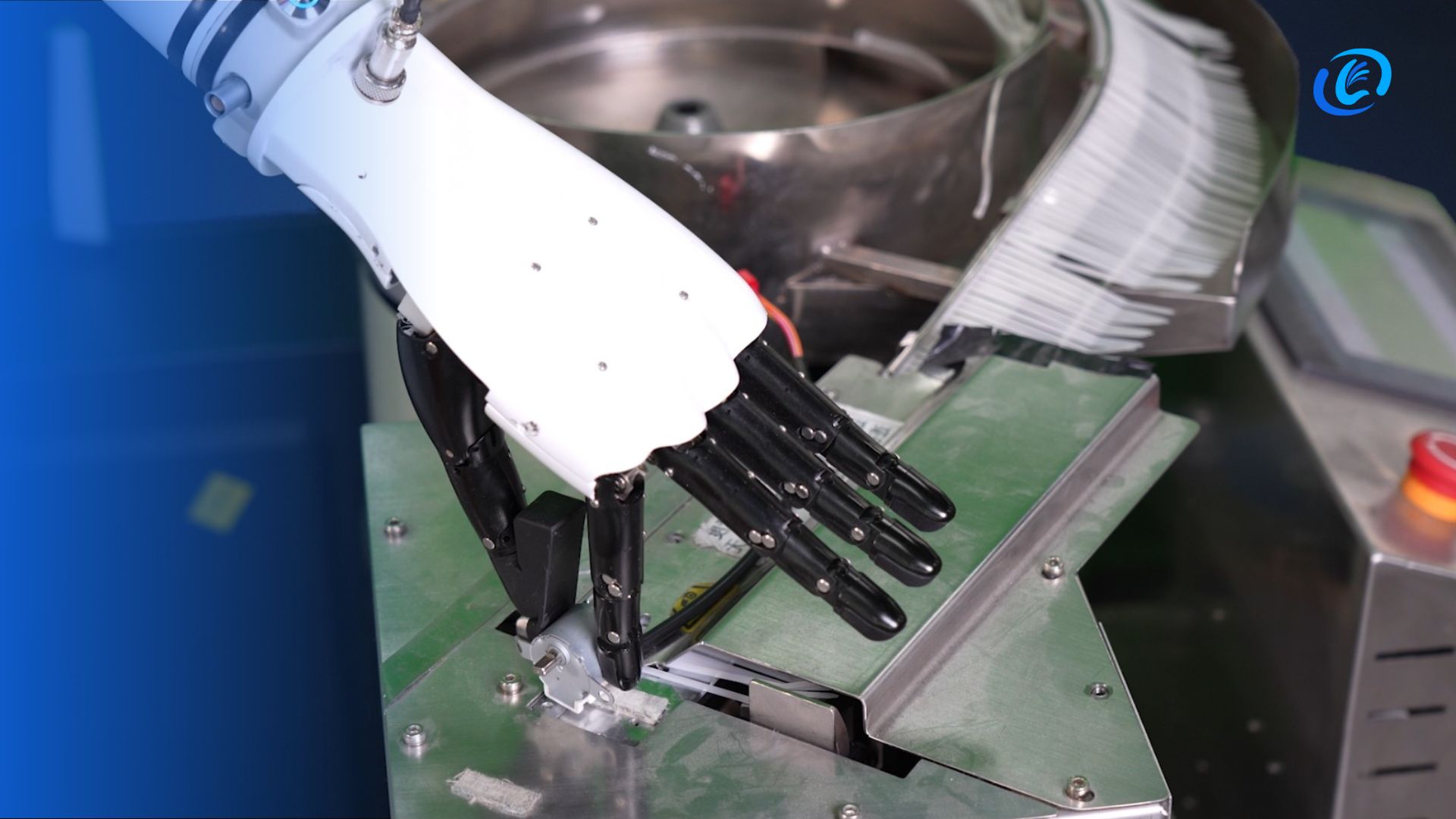
Two LG-601 dexterous hands operate collaboratively and finish the full workflow of "identification – grasping – arrangement – fastening" in 9 seconds: The 3D vision system identifies terminal positions and wire routing → the control system calculates the optimal grasping path and action sequence → dual robotic arms move the dexterous hands to target positions → the two dexterous hands separately grasp terminals, straighten wires and fasten cable ties, while force sensors adjust clamping force dynamically.
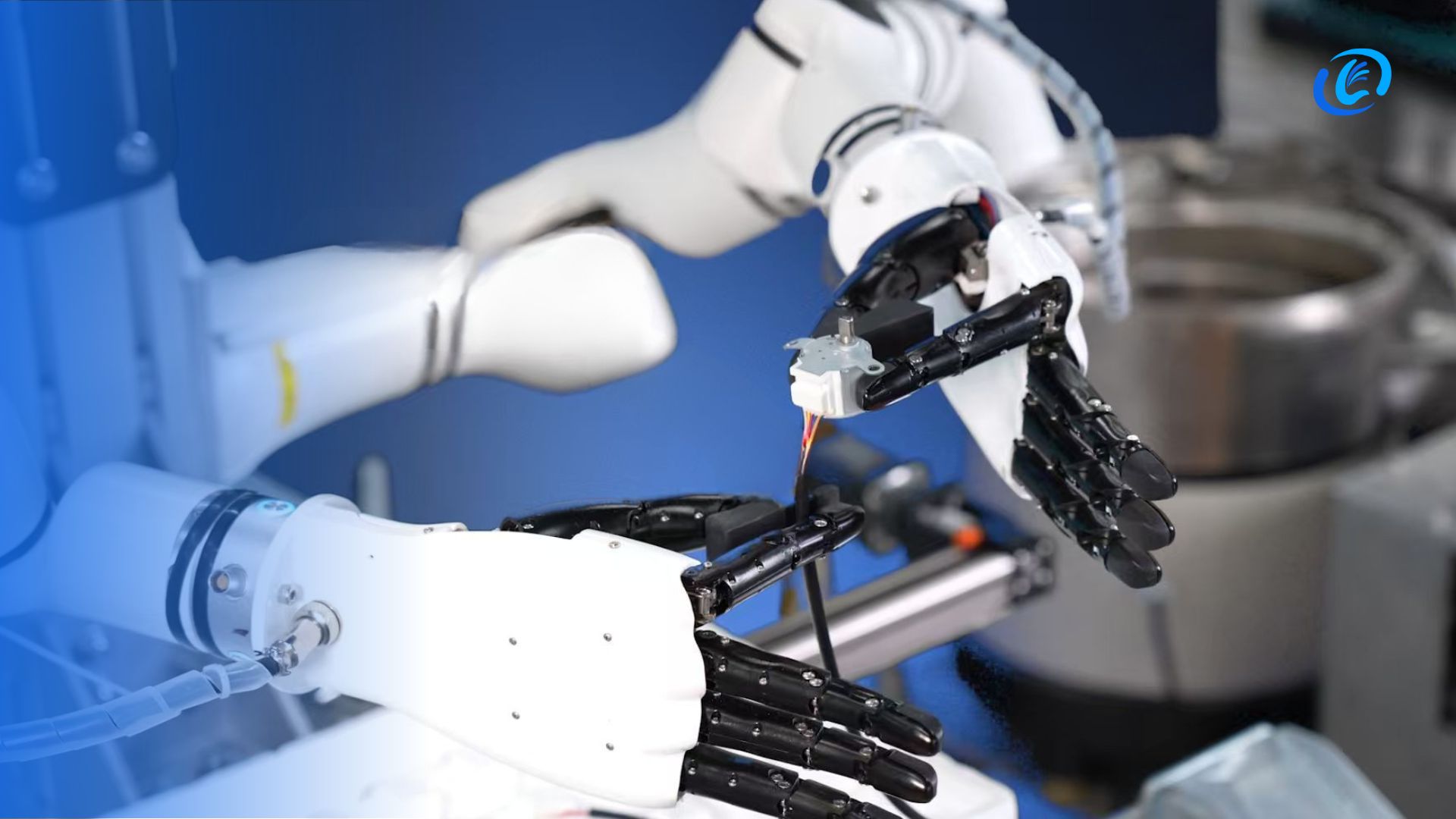
The whole process requires no manual intervention and no changeover commissioning. Compatible with more than 10 motor models, it achieves an assembly yield above 99%.
More importantly, this solution is replicable. The first deployment is customized, but once validated in the scenario, it becomes a standard solution readily available for subsequent similar customers without redevelopment from scratch. Therefore, Zhongke Lingxi follows this logic: the first scenario is custom-built, and the second one adopts a standard solution.
Results
Data Speaks for Itself
Zhongke Lingxi’s solution addresses technical challenges while maintaining cost-effectiveness. The following on-site test comparisons intuitively demonstrate improvements brought by the upgrade:
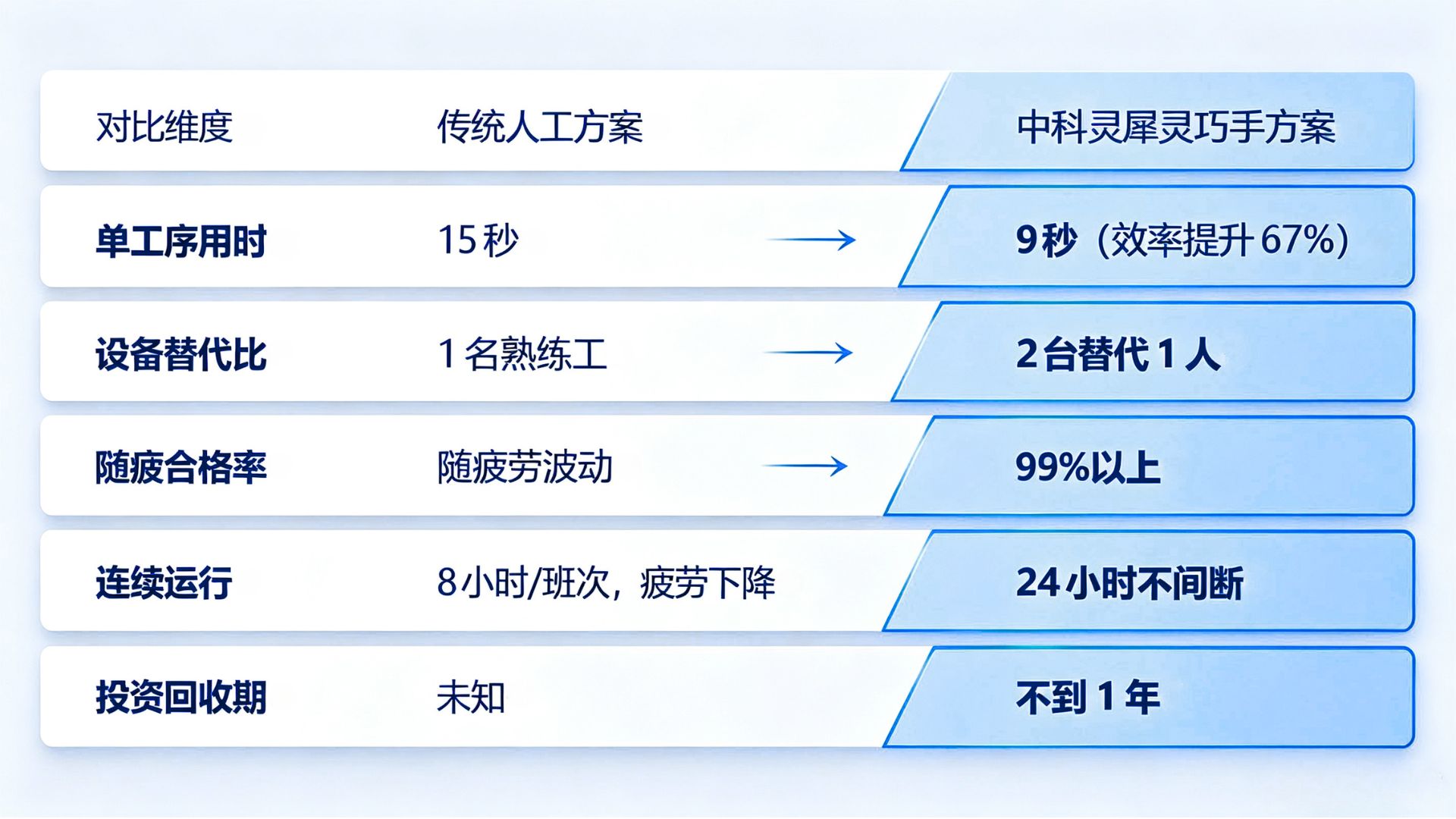
A skilled operator works 8 hours per day with efficiency declining due to fatigue. Two dexterous hands run nonstop for 24 hours, taking no leave and requiring no turnover.
Stability stands out most — the system has run continuously on the production line for over a year, accumulating more than 10,000 operating hours with zero failures. These are not lab data but authentic production logs.
Why Zhongke Lingxi Is Capable of Delivering This
Flexible harness assembly is widely recognized as an industry challenge. Many enterprises attempted hardware upgrades but failed to achieve mass deployment. Zhongke Lingxi succeeded not by virtue of a single proprietary technology, but by its hard-to-replicate comprehensive capabilities in three aspects:
First, closed-loop system. Most competitors only supply hardware — selling dexterous hands and leaving other integrations to customers. Zhongke Lingxi delivers a complete "hand-eye-arm-brain" closed-loop system with independent R&D and full connectivity across all four modules. Customers obtain a fully functional workstation instead of a standalone dexterous hand.
Second, cost advantage. Supported by the industrial chain of listed company Jiangsu Leili and deeply bonded strategic suppliers, all core components are domestically produced. Its BOM cost is 30%–50% lower than competitors. It delivers higher performance at the same cost and lower cost at the same performance. This low cost is not achieved by compromising quality, but a structural benefit derived from deep industrial chain integration.
Third, replicability. The first unit is custom-engineered, yet it turns into a standard solution once validated. The same dexterous hand platform solves similar problems across different industries for tasks that are undesirable, difficult or strenuous for human workers.
Feedback
Authentic Voices from the Production Line
Production Line Technical Lead:
"Your dexterous hands meet the requirements of our smart upgrade in terms of force control and response speed. We used to think automated equipment was bulky and inflexible, never expecting dexterous hands to handle such delicate tasks."
Production Supervisor:
"Previously, one operator was assigned to each workstation for an 8-hour shift with dropping efficiency over time. Now two devices replace one person and run 24/7. The investment is recouped within less than a year. Such ROI is rare for production line retrofits."
Quality Engineer:
"Manual bundling used to result in batch consistency entirely dependent on workers’ conditions. Since the dexterous hands went online, the yield has stabilized above 99%. I no longer have to chase rework orders every day."
Equipment Maintenance Engineer:
"Nothing worries me more than frequent equipment breakdowns. This system has operated for more than a year without a single fault. Switching among over 10 motor models needs no changeover tuning, which is very reassuring."
A Broader Vision
Paradigm Shift in Flexible Assembly
From motor assembly to harness insertion, from cable tie bundling to precision alignment — the "last centimeter" precision assembly in industry is being redefined by dexterous hands.
This is not merely an equipment upgrade. It represents a paradigm shift for production lines: shifting from "humans adapting to machines" to "machines adapting to tasks", and from rigid automation to flexible intelligence.
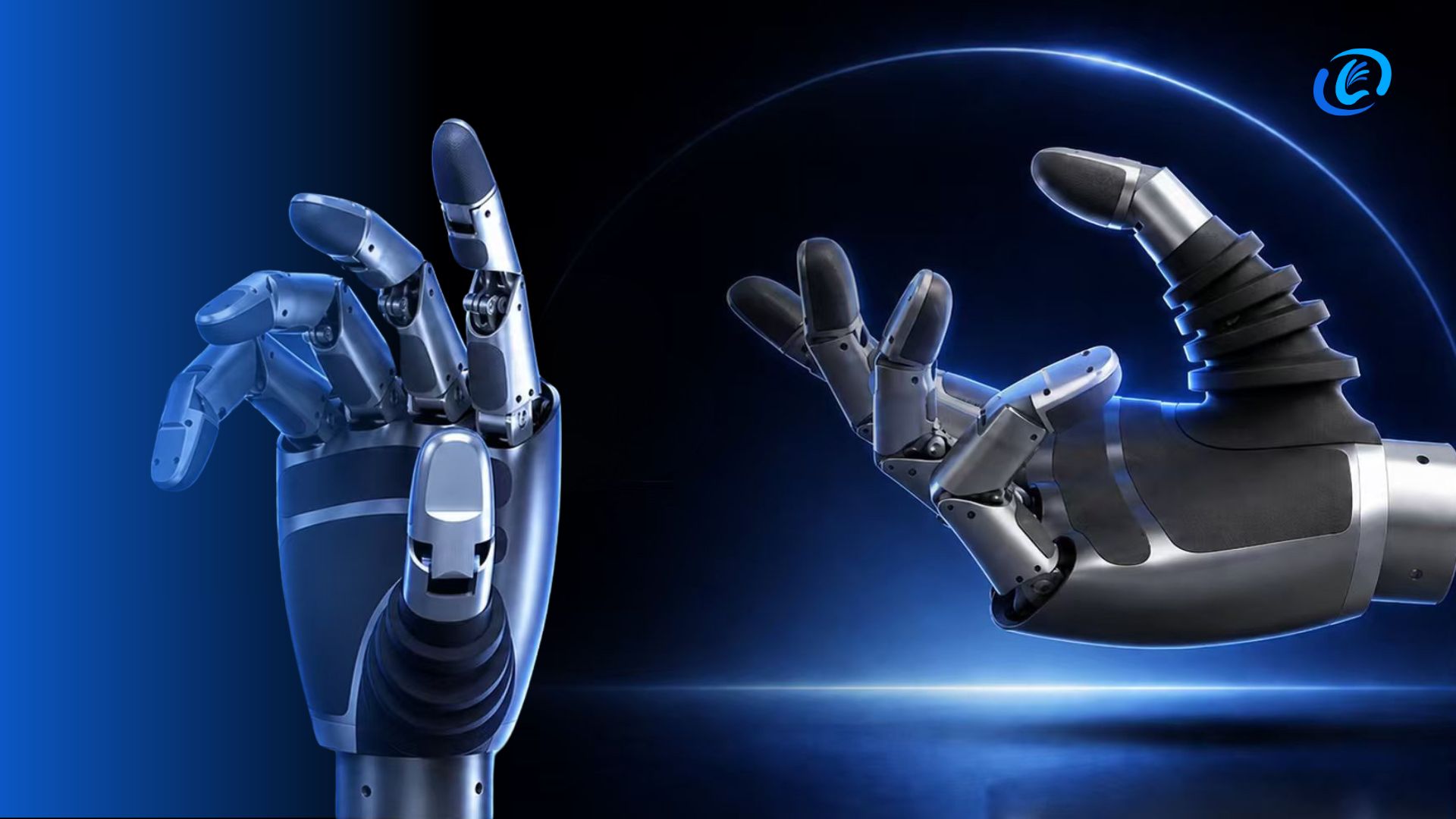
Zhongke Lingxi’s dexterous hands have been deployed on live production lines. With over one year and 10,000 hours of zero-failure operation records, they prove to be more than just laboratory concepts. The same dexterous hand platform addresses similar tasks across diverse scenarios, including high-risk sampling in chemical plants, precision motor assembly and fire control room monitoring — all jobs that are undesirable, difficult or strenuous for human workers.
The next stop covers more precision assembly workstations. Beyond that lies every industrial site requiring a pair of capable hands. From chemical and power industries to 3C and food sectors, Zhongke Lingxi’s dexterous hands are entering more fields where human operators struggle. It finds application wherever flexible manipulation is demanded.